
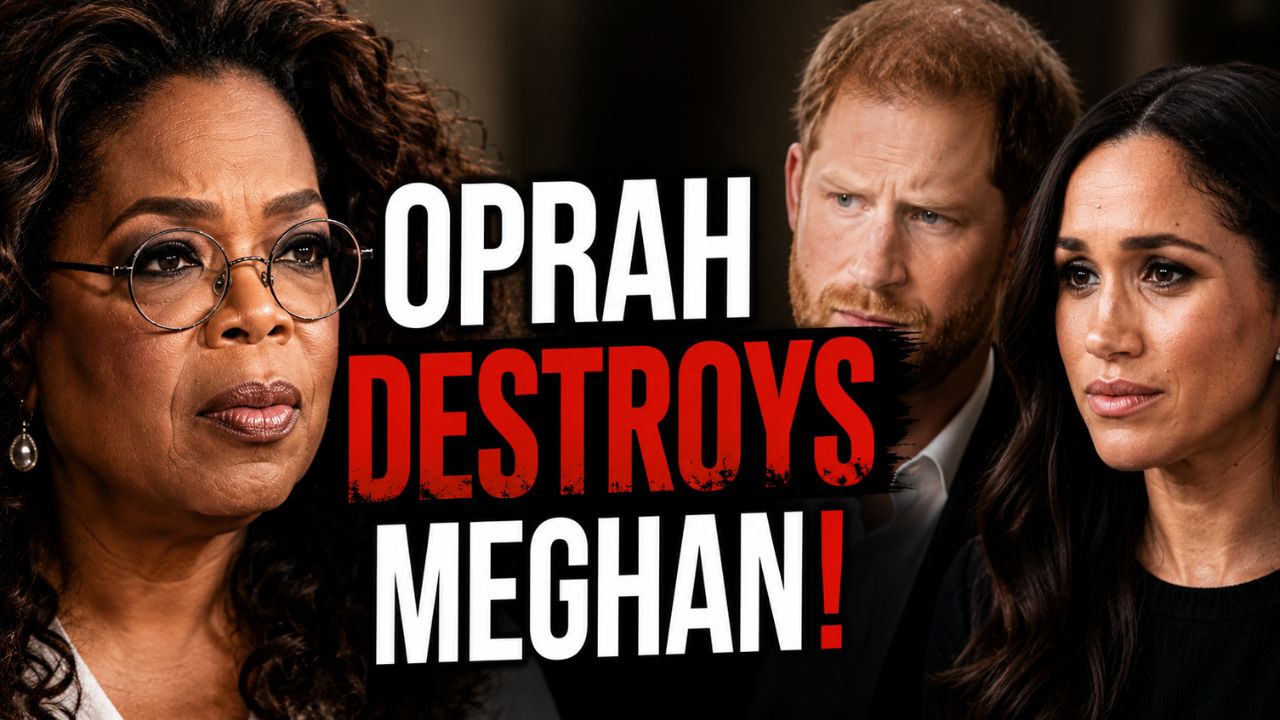
More than five years after one of the most controversial television interviews in modern history, Oprah Winfrey is once again making headlines. This time, however, the attention isn’t centered on what Prince Harry and Meghan Markle said during their explosive 2021 interview. Instead, the spotlight has shifted to Oprah herself after she reflected on how the interview was conducted and the thinking behind some of its most memorable moments.
Her recent comments have reignited debate about journalism, media ethics, celebrity interviews, and the lasting impact the conversation had on the British Royal Family. While supporters believe the interview gave Prince Harry and Meghan Markle an opportunity to tell their personal story, critics argue it lacked the rigorous questioning expected from one of the world’s most respected interviewers.
Years later, the interview continues to influence discussions surrounding the Royal Family, media credibility, and the responsibilities of journalists when covering highly sensitive allegations.
The Interview That Changed the Royal Conversation
When Oprah Winfrey sat down with Prince Harry and Meghan Markle in March 2021, the interview immediately became one of the most-watched television events in the world.
It was the Duke and Duchess of Sussex’s first major television appearance after stepping away from their duties as senior working members of the British Royal Family. Millions tuned in to hear the couple discuss why they left royal life and how their experiences inside the monarchy affected their personal lives.
Throughout the interview, Harry and Meghan spoke about mental health, media scrutiny, royal protocols, family relationships, and concerns surrounding their son Archie. The interview quickly dominated global headlines, generating widespread discussion across television, newspapers, social media, and political circles.
Supporters praised the couple for sharing deeply personal experiences, while critics questioned whether some of the most serious allegations had been sufficiently challenged during the interview itself.
Oprah Reveals New Details About the Interview
Years after the broadcast, Oprah recently reflected on the interview during a discussion looking back on defining moments from her career.
She explained that the interview did not happen as originally planned. According to Oprah, it had been postponed several times before finally taking place in California during the COVID-19 pandemic.
She also revealed that the conversation lasted approximately three and a half hours, considerably longer than what audiences eventually saw on television.
According to Oprah, she entered the interview intending to discuss every major issue that had surrounded Prince Harry and Meghan Markle in the months leading up to the broadcast.
However, one statement immediately attracted public attention.
Oprah said she wanted the interview to be a “win-win.”
Although she appeared to mean that both the interview subjects and viewers would benefit from an open conversation, critics interpreted the phrase very differently.
Why the “Win-Win” Comment Sparked Controversy
The phrase quickly became one of the most discussed parts of Oprah’s recent remarks.
Media commentators questioned whether journalism should ever be approached as a “win-win” situation.
Traditionally, journalists are expected to prioritize uncovering facts, testing claims, and asking difficult follow-up questions regardless of how uncomfortable those questions might become for interview subjects.
Critics argued that describing such a high-profile interview as mutually beneficial suggested a softer approach rather than a rigorous journalistic investigation.
Supporters disagreed.
They argued that Oprah has long been known for conducting conversational interviews rather than courtroom-style interrogations.
They also noted that long-form interviews often encourage guests to speak more openly by creating a comfortable environment rather than a confrontational one.
The debate ultimately reflects two very different philosophies of interviewing.
One prioritizes empathy and openness.
The other prioritizes immediate verification and accountability.
Revisiting the “Silent or Silenced” Question
Perhaps no moment from the original interview became more famous than Oprah asking Meghan Markle whether she had been “silent or silenced.”
The question quickly became one of the defining images from the entire broadcast.
Recently, Oprah explained why she asked it.
According to her, she wanted to clarify whether Meghan was choosing not to speak publicly or whether someone had actively prevented her from speaking.
However, critics argue that clarification required more than simply asking the initial question.
Many believe stronger follow-up questions should have explored who allegedly silenced Meghan, when it happened, what actions were taken, and what evidence supported those claims.
Supporters counter that Oprah’s role was to facilitate conversation rather than aggressively cross-examine her guests.
That disagreement remains one of the central issues surrounding the interview today.
The Broader Debate About Journalism
Oprah’s recent comments have revived broader conversations about the responsibilities of journalists interviewing influential public figures.
Should interviewers simply provide guests with a platform to explain their experiences?
Or should every major allegation be immediately challenged before being presented to millions of viewers?
There is no universal agreement.
Some believe empathy encourages honesty and allows important stories to emerge naturally.
Others argue that extraordinary claims require immediate scrutiny to protect both public trust and those being discussed.
The Harry and Meghan interview has increasingly become a case study in journalism schools and media discussions because it illustrates the delicate balance between compassion and accountability.
How Public Opinion Has Changed Since 2021
When the interview first aired, many viewers accepted the couple’s account at face value.
Over time, however, additional interviews, documentaries, legal proceedings, and Prince Harry’s memoir Spare introduced new details that encouraged audiences to revisit the original broadcast.
Some observers believe later comments clarified earlier statements.
Others argue that differences between various public accounts created new questions.
Because of these developments, the interview is now viewed through a much broader historical lens than it was immediately after its release.
Rather than existing as a single television event, it has become part of an ongoing public narrative involving Prince Harry, Meghan Markle, and the Royal Family.
The Ongoing Discussion About Privacy
Another aspect of Oprah’s recent comments that attracted attention involved her reflections on fame and privacy.
She shared a story from earlier in her career when she attempted to make a simple shopping trip but was repeatedly recognized by members of the public.
Eventually, she returned home without completing her errand.
The experience led her to adopt a practical philosophy regarding public life.
According to Oprah, if she genuinely wanted complete privacy on a particular day, staying home was often the simplest solution.
Although she acknowledged that royalty faces different circumstances than celebrities, many observers interpreted the story as an indirect response to Prince Harry and Meghan Markle’s long-running concerns about media intrusion.
Supporters argue that the comparison is limited because members of the Royal Family face constitutional responsibilities, intense international attention, and unique security considerations.
Others believe Oprah was making a broader point about the unavoidable compromises that accompany global fame.
The Royal Family Has Moved Into a New Era
Since the interview aired, the British Royal Family has undergone significant changes.
Following the death of Queen Elizabeth II, King Charles III became monarch.
Prince William and Catherine, Princess of Wales, have taken on increasingly important responsibilities as future leaders of the monarchy.
Their approach to public life has generally focused on official engagements, charitable work, and carefully managed family appearances.
Images and occasional videos featuring Prince George, Princess Charlotte, and Prince Louis are released selectively, giving the public carefully controlled glimpses into their lives while maintaining a high degree of privacy.
Many royal commentators see this as an example of balancing public interest with personal boundaries.
Why the Oprah Interview Still Matters
Few television interviews continue generating discussion years after they first aired.
The Oprah interview remains an exception.
It influenced global conversations about the monarchy, race, mental health, media treatment, privacy, celebrity culture, and journalism itself.
Its impact extended far beyond entertainment news.
Governments, broadcasters, newspapers, historians, royal experts, and audiences across the world all weighed in on the issues raised during the broadcast.
Even today, every major development involving Prince Harry, Meghan Markle, or the Royal Family often brings renewed attention to the interview.
Oprah’s Legacy and Public Perception
For Oprah Winfrey, the interview has become one of the defining moments of an extraordinary broadcasting career.
Having interviewed presidents, world leaders, entertainers, athletes, and cultural icons over several decades, Oprah has built a reputation as one of television’s most influential interviewers.
Her recent reflections suggest she recognizes how significant the Harry and Meghan interview remains within that legacy.
Whether her comments represent clarification, personal reflection, or an effort to explain her approach is ultimately left to public interpretation.
What remains clear is that the interview continues shaping conversations about journalism and public trust long after it originally aired.
Final Thoughts
More than five years later, Oprah Winfrey’s interview with Prince Harry and Meghan Markle continues to stand as one of the most influential media events of the 21st century.
The recent attention surrounding Oprah’s reflections demonstrates that the interview’s legacy is still evolving.
For some, it remains an important conversation about personal struggles inside one of the world’s most famous institutions.
For others, it serves as a reminder of the importance of rigorous questioning whenever serious public allegations are presented on a global stage.
Regardless of perspective, the interview continues to influence discussions surrounding the British Royal Family, media ethics, celebrity influence, and public trust.
Its impact reaches far beyond a single evening of television, ensuring that it will remain part of conversations about journalism and the monarchy for years to come.